Friday, August 28, 2009

10 Tips to Start the School Year off Right


We always tell our kids to start the school year off right. We give them tips on how to impress teachers, how to be prepared, how to get organized, etc. But, we need to think about how we can start the school year off right, too.

Here are 10 of my tips:

1. Don’t over schedule your children this school year. Benefits: you save money, get more time at home as a family and are generally less stressed out when you’re not driving your kids around after school running from one activity to the next.

2. Don’t sign your child up for academic tutoring unless he/she is in jeopardy of failing a class. (Don’t pay for a tutor to boost a “C” or “B” to an “A”.) Benefits: same as in #1 and you are sending the message to your child that he/she is fine the way he/she is. You will trust the teachers to do their jobs. They will get a better indication of your child’s ability if your child isn’t getting extra outside help (this includes helps from you, too).

3. Don’t ask your kids about grades, test scores or homework. Instead, focus on the content of the subject. (Instead of “What did you get on the test?” say, “What are you learning in science?” If you are connected to some school communication tool (like Schoolloop) you can look at homework assignments and grades privately. Benefits: you are teaching them to take ownership of their own schedules. You are letting them manage their own time. You are taking the focus off scores and putting it on learning. You are alleviating stress in their lives.

4. Give your kids at least an hour of down time after school. Benefits: they will be more cooperative and happy if they can de-stress and “chill-ax” after spending 7 hours at school.

5. Have your child do daily or weekly chores – lawn mowing, sweeping, cleaning toilets, vacuuming, taking care of the family pets, etc. Plan, prepare, cook and cleanup meals with your child. Benefits: you will be less stressed because you will have more help around the house, your child will learn about the responsibility of being part of a family. You will be spending more time with your child.

6. Don’t yell at your kids during homework time; you are not the homework enforcer. If they spend more that 10 minutes a night per grade level, email or talk to the teacher. (ie., 10 minutes/night in 1st grade, 40 minutes/night in 4th grade, etc.) Benefits: you will get along with your kids better. Your kids will see that you value family time over work time. Your kids will have more balance in their lives.

7. Don’t go to every scheduled sports game or extracurricular activity of your child’s. Benefits: your child will be participating for the love of the game or of the activity, not to earn your approval.

8. Encourage unstructured outside neighborhood activities after school - a walk, a bike ride, hide-n-seek, skateboarding, picking flowers, building something, drawing on the sidewalk with chalk, etc. Benefits: your child will get exercise and use his/her imagination. Your child might meet friends in the neighborhood. You will be less stressed because you won’t be driving him/her somewhere. You will use less gas and that’s good for the environment!

9. Don’t use rewards and punishments with regard to school and sports. Benefits: the focus shifts from seeing our children as performers to seeing them as themselves.

10. Let your children fail. Benefits: they will make discoveries.

Thursday, August 20, 2009

Old Homework Papers


What do you do with old homework papers? During the school year my boys pile up their old homework papers in a cabinet. By the end of the school year these piles are usually around 12 inches high. Then they take one day during the summer to sort through these papers. But, they always moan and complain when I ask them to do this.

I ask them to save anything that was meaningful to them as they sort through the huge stack. They usually end up with some small assortment of writing samples, artwork, tests/assignments that got high grades, cards from friends and teachers, etc. Their piles of papers reduce down to about 2-3 inches high, small enough to put into a 3-ring binder. They now have a collection of 3-ring binders, one from each school year, sitting on the shelves in our family room.

Every once in a while they look through these binders. I ask them what they think. Are they proud of any of their work? Did they enjoy any of these assignments? Did they learn a lot from all this work?Their answers are usually negative. “I hated doing this assignment.” “Look at this big packet and I don’t even remember any of it.” “I want to burn this!” “What a waste.” “I worked so hard and she only gave me a C on this.” Etc… Occasionally they are proud of their work (like projects, or artwork, or an assignment they got a high grade on) and remember it fondly.

Why do I ask them to make these homework binders? I am a huge fan of portfolios and the schools my boys have attended don’t really use them. So, this is my version of their school portfolio for each year – a binder with self-selected works in it that shows effort, participation, improvement and, hopefully, some learning.

The other reason I have them do this is that it helps my youngest if he struggles with certain subjects. He can go to his older brother’s binder, and look up his work, tests, or papers and get ideas to help him get through the subject when he takes it. Often, if they have had the same teacher, the tests will be identical and he’ll be able to study from them. I don’t consider this cheating. I consider it making the best of a bad situation. If a teacher gives the same test year after year, in my opinion, she isn't putting forth her best effort and is most likely uninspired. That is a shame.

In my ideal world, students would not bring home piles of homework papers they want to throw away, but instead would bring home, at the end of the school year, their own student-made textbooks and/or portfolios, ready-made to display proudly on the family room bookshelf. And these books would have been made during class time, NOT during family time after school or on weekends.

Monday, August 10, 2009

Summer Camp Learning


Did you ever go to summer camp as a kid? Do your children now go to summer camps? Most camp experiences are fun and kids learn a lot. I often wonder why school can't be more like camp. Sometimes schools offer activities that are camp-like, for example, field trips and assemblies. Some schools even send their older students away to camp. But, more often than not, school just doesn't feel like camp.
What is it about summer camp that can be so great for kids? Often it involves choice - students decide what camp they want to attend, or what activities they want to do during the day. Camp is all about meeting new friends, learning about their interests, getting to know them better. Camp usually involves learning cool stuff in interesting, hands-on ways. At camp, kids sometimes go out of their comfort zones and take risks they don't normally take. Kids usually work in teams to achieve goals at camp. Kids sing at camp, and make lots of art projects. There is no homework at camp. There are no standardized tests or grades at camp. Camp is fun!
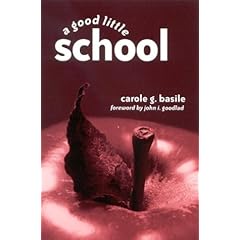
Why can't school be more like summer camp? It can be. Some schools are more like summer camp. I just read a book called, "A Good Little School" by Carole G. Basile about a school in Colorado called Jefferson County Open School. To order, here's the link: http://www.amazon.com/Good-Little-School-Carole-Basile/dp/079145892X .

At this school teachers focus on three domains of their students - personal, social, and intellectual. This is a different approach from many schools that focus primarily on the intellectual, academic aspect of school, i.e., filling our students up with knowledge.
The goals of Jefferson County School are:
1. to re/discover the joy of learning
2. to seek meaning in life
3. to deal with what is
4. to prepare for what will be
5. to create the world that ought to be
How do they do this? They put students of different ages together for several years (K-2, 3-6, 7-8, 9-12), all students have advisors who follow their progress, students have a lot of personal choice in their learning, much of the learning is self-directed, students become a part of their community, all students have I.E.P.'s (individualized education plans), the focus is on global citizenship instead of global competition, teachers use portfolios instead of testing and grades. 
I believe that even if most schools are not exactly like this school, teachers, administrators and parents can work together to bring many aspects of this type of school and the joy of summer camp learning into our classrooms. Do you know of any other schools that are accomplishing this? If so, please leave a comment below because I'd like to learn about them.