
Tuesday, November 24, 2009

Another Reason to Love Canada


In addition to its great hockey and the dozen or so wonderful friends I’ve met from Canada, I now have another reason to love Canada. Canada is becoming more and more progressive with regard to homework. Yea!

Last week many Canadian newspapers, radio and TV reported the story of the Milleys, lawyer parents from Calgary, Canada, who have successfully negotiated an individual contract with their children’s school allowing them to opt-out of homework. You can go to Sara Bennett’s blog StopHomework.com for more information.

Here is an editorial (also from StopHomework.com) from The Globe and Mail discussing this historic “peace treaty.”

For those of you geographically challenged Americans (like me!) who aren't sure exactly where Calgary is, I’ve included a map above.

I’m not surprised Canada is on the ball with regard to homework. When I was on the homework task force for our school district, I urged the task force to consider modeling our policy after Toronto’s. You can see Toronto’s policy here. There’s a lot of good stuff in it, like this:

"If homework is not completed, consequences shall not be punitive. There is no connection between punitive measures and student achievement, punitive measures actually provide powerful disincentives."

BTW, Toronto is nowhere near Calgary (geographically) - you can see this on the map - yet both sides of the country seem to be connecting on the homework issue.

The main reason I agree with a homework opt-out policy is that it gives parents and students choice.

Another reason I like it is that using it means teachers won’t grade homework. Homework shouldn’t be graded (in my opinion) because sometimes parents do homework for their children. Or, kids cheat off other kids and don’t do their own homework. Teachers can’t really be sure how to gauge the student’s learning if the work is done outside of the classroom.


[If homework can be cheated on, it isn't a good homework assignment to begin with...in my opinion.]

In my ideal school setting kids (of all ages) would be busy working on their (multi-disciplinary) projects and individual learning plans. Teachers would be walking around helping students as needed and every so often bringing the class together for a short lesson. Teachers from other subjects would be on hand, too, to answer questions. In this scenario, homework isn’t even an issue because most of the work would get done in the classroom. And if a student needed to bring some work home to finish or embellish, that would be fine, but they wouldn’t be graded on anything until the project is complete. I also wouldn’t have tests in my project-based learning scenario.

So, if more parents and schools (and countries!) accept homework opt-out policies, perhaps it would open the door to even more progressive thinking in terms of homework, teaching and learning.

Do you agree or disagree with homework opt-out policies? You can join a discussion about it at: http://www.squidoo.com/homework-opt-out-policy

Monday, November 16, 2009

What You Can Do

The "Race to Nowhere" documentary website now includes a petition. I've copied it below. You can go there to sign the petition.

"We invite you to add your voice to a growing movement of educators, parents, medical professionals, policy makers and concerned citizens who want to see real change in education policies and practices.

Too many students in all grades in the U.S. are under undue performance pressure and stress, get too little sleep and exercise, have too much unnecessary homework, and attend schools that are overly focused on standardized test scores, grades, and/or college admissions. Too many teachers are unable to engage in quality teaching because they have inadequate resources or are under too much pressure from federal, state, district and board mandates that force them to “teach to a test” as they attempt to “cover” an unrealistic volume of content.

As a result, students are no longer in classrooms that challenge them to solve complex problems and think creatively, to work collaboratively on projects, to explore issues with real-world connections, and to develop the real skills needed to succeed in the 21st century and the global economy. Many students are exhausted, anxious, disengaged, unhealthy and unprepared for the future.

Petition

We the undersigned demand educational policies and practices that recognize EVERY child as a “whole child” and promote quality teaching in EVERY school so that every child has an opportunity to engage in meaningful learning, recognizing there are may paths to a successful future.

We ask to see a transformation of U.S. education in the 21st century and demand policies and practices that are in line with the known developmental needs of children and adolescents and which authentically engage students in developing inquiring minds without interfering with their right to a healthy childhood.

This petition will be presented to all major stakeholders including U.S. Secretary of Education Arne Duncan, members of Congress, as well as members of state boards of education, state legislators, and local boards of education. We also encourage the use of this petition in your local school community."


Please pass on the link to friends, family, students, educators, spouses, etc. I've also included a direct link on the right side bar of this blog.

Monday, November 9, 2009

45 Years Later, Same Ole’ Same Ole’

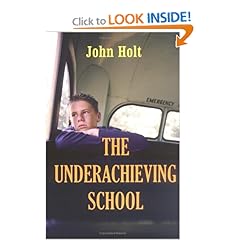
I just finished The Underachieving School by John Holt. It’s a collection of essays about education written by Holt in the 1960s, but it could have been written today.

About the author:

John Holt was born in 1923 in New York City and raised in New England. He went to private schools, but he chose not to reveal the names of the schools he attended because he felt that was irrelevant. He said, "... the things I'm supposed to know so much about I never learned in schools." He taught in private schools for many years before writing his first book, How Children Fail, in 1964. This book and How Children Learn, 1967, have sold over a million and a half copies. Holt’s clear writing and empathic understanding of children has made these books favorites of many teachers, parents and homeschoolers.

Some quotes from The Underachieving School:

· “Education is something a person gets for himself, not that which someone else gives or does to him.”

· “When children give wrong answers it is not so often that they are wrong as that they are answering another question.”

· “[The student] comes to feel that learning is a passive process, something that someone else does to you, instead of something you do for yourself.”

· “The child soon learns not to ask questions: the teacher isn’t there to satisfy his curiosity…he soon comes to accept the adults’ evaluation of him.”

· “It is a very recent idea, and a crazy one, that they way to teach our young people about the world they live in is to take them out of it and shut them up in brick boxes.”

· “Let’s get rid of all this nonsense of grades, exams, marks. We don’t know how, and we never will know how to measure what another person knows or understands…let the children learn what every educated person must some day learn, how to measure his own understanding, how to know what he knows or does not know.”

· “Somewhere we got the crazy notion that a class would learn most efficiently if everyone was learning the same thing at the same time. As if a class were a factory.”

· “Too often it is school and nonstop talking teachers that turn them into inert and passive learners.”

· “What true education requires of us instead is faith and courage—faith that children want to make sense out of life and will work hard at it, courage to let them do it without continually poking, prying, prodding and meddling. Is this so difficult?”

John Holt died in 1985. I’m sorry he didn’t get to see his dream of a real reform of public education realized before his death. I’m still waiting for the reform myself.

Monday, November 2, 2009

Letter from a Math Teacher

This year after Back to School night at both the middle and high schools my boys attend, I sent each of their teachers an email. In the email I said I had just read a really interesting book called “Rethinking Homework” by Cathy Vatterott and I had some extra copies I’d like to share with anyone interested.

To my surprise I got a few emails back right away from teachers at both schools saying “sure, I’d like to borrow the book.” Well, just last week I got a nice letter back from my 10th grader’s geometry teacher. I received permission from him to reprint it:

“Hi Kerry,

Thanks for the loan of the book. It generated much “rethinking” at lunch in the math dept. While many of us were initially skeptical about a new homework paradigm, we found ourselves agreeing with much of the book. We are opposed to “busy work” and grading homework for accuracy. I hope that my assignments are appropriate, both as regards length of time and amount of practice. In Calculus, I think it appropriate to give homework no weight, but in my classes, I need to reward the effort – about 10-15% seems right.

I feel bad when I see my students losing sleep to do projects of questionable value, and pledge that I will never do this. Sometimes, if I must spend more time on questions than I planned, or there is a short period for some forgotten reason, I may give more homework than you feel appropriate. If so, I apologize.

Thanks again”

This particular teacher has been teaching at the high school for over 20 years. I was pleasantly surprised (and told my son so) that he was open to reading a book on homework and took the next step by sharing and discussing it with his colleagues.

My son hasn’t complained about his math homework this year, he just accepts it as a fact of life, but there have been years that math has been a real struggle for him. Even so, I think it always encouraging when a teacher (especially one who has been teaching for so long) is willing to re-think the homework he/she is assigning.

So what did I do after I received his letter? I emailed the principal letting him know how pleased I was that this teacher took the time to read and think about this book. I also sent another book to school with my son for the same teacher. This one is called “The Mathematician’s Lament.” It discusses how we kill the love of math by teaching it the way we do. It also gives suggestions for ways to teach it better.

I wanted to post about this because I think it’s important to know that parents really can have an impact on teachers -- not all teachers are set in their ways. Some are open to new ideas.