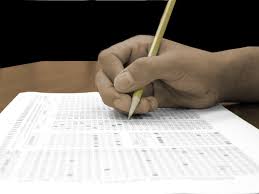
What is STAR testing?
“Each spring, California students take a battery of standardized tests that comprise the state's STAR (Standardized Testing and Reporting) Program. The key component of the program measures students’ achievement of state academic content standards. The program began in 1998.
All students in grades 2-11 participate in the STAR Program, including students with disabilities and students who are English learners.
California's school accountability system, the Academic Performance Index (API) is based primarily on results from the STAR program, as well as the California High School Exit Exam (CAHSEE).”
[Taken from… http://www.ed-data.k12.ca.us/articles/Article.asp?title=Understanding%20the%20STAR]
I’d like to mention two often unknown facts about STAR testing.
Fact # 1. STAR testing is NOT mandatory. That is, parents can have their children opt out of STAR testing if they wish by simply writing a letter to the school’s principal.
“Parents may request in writing to the principal that a student not be tested.”
[Taken from… http://www.ed-data.k12.ca.us/articles/Article.asp?title=Understanding%20the%20STAR]
According to California Code of Regulations, Title 5, Education, Division 1, Chapter 2, Subchapter 3.75, Standardized Testing and Reporting Program, sections 852:
“(a) A parent or guardian may submit to the school a written request to excuse his or her child from any or all parts of any test provided pursuant to Education Code section 60640. A school district and its employees may discuss the Standardized Testing and Reporting program with parents and may inform parents of the availability of exemptions under Education Code section 60615. However, the school district and its employees shall not solicit or encourage any written exemption request on behalf of any child or group of children.”
[Taken from: http://www.cde.ca.gov/ta/tg/sr/admin.asp]
When my children were in elementary school, I wasn’t aware that STAR testing was optional. If I had known then what I know now, I would have opted out of STAR testing in grades 2-5. At grade 6 my husband and I would have evaluated the benefits versus drawbacks of the testing, and re-evaluated our decision based on the specific needs of each of our children.
Last year, when I became aware that this testing was optional, we decided to opt out of the STAR test for our 7th grader who has test anxiety and other learning issues. This year we have decided to have him take it in 8th grade primarily for one reason: practice for the California Exit Exam (CAHSEE) which he is required to take, and pass in 10th grade, in order to graduate from high school.
I believe that standardized tests are not preparation for life, but are preparation for more standardized tests. And these tests play a big role in institutionalized education for many years for our children. If our children want to achieve a satisfactory result on these tests, they will have to practice taking them. However, I firmly believe that they do not need to begin practicing these tests until the middle school years, and then only if the benefits of taking the tests outweigh the detriments. That must be determined by each family depending on the needs of each individual child.
Fact # 2. Teachers are not supposed to teach to the STAR test.
Education Code Section 60611:
“a) A city, county, city and county, or district superintendent of schools or principal or teacher of any elementary or secondary school shall not carry on any program of specific preparation of the pupils for the statewide pupil assessment program or a particular test used therein.”
b) A city, county, city and county, district superintendent of schools, principal, or a teacher of an elementary or secondary school, including a charter school, may use instructional materials provided by the department or its agents in the academic preparation of pupils for the statewide pupil assessment if those instructional materials are embedded in an instructional program that is intended to improve pupil learning.”
I was a bit annoyed yesterday when my 8th grader came home with a word search of math terms for Algebra homework. I see little value in an assignment like this and see it as busy work. It seems to be a waste of the student's and teacher's time. In addition to that, when I asked my son what he was doing in Algebra this week, he said he was copying down terms from the glossary to prepare for STAR testing. Again, I see this as a waste of all 8th grader's valuable class time.
I would like to see more constructive use of class time where students are actively engaged in learning about Algebra instead of a narrow focus on one component of the STAR test (math terms from the glossary). I would also like to see either no homework or homework that is a valuable extension of the learning that really helps students become interested and engaged in Algebra.
How do we get students to begin thinking like mathematicians? Certainly not by doing word searches and copying terms from the glossary to prepare for STAR testing!
What has your experience been with standardized testing?