Showing posts with label education. Show all posts

Thursday, May 31, 2018

Are You a Carpenter or Gardener Parent?


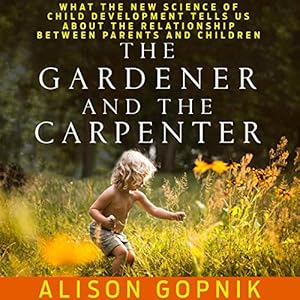
I just listened to an informative podcast by NPR's Shankar Vendantam about parenting.  You can find the link here.  He interviewed Alison Gopnik, psychology and philosophy professor at Berkeley about two models of parenting, the carpenter versus the gardener model.

Listen to the podcast and see what type of parent you are.

The one thing that bothered me about the questions Shankar asked Alison was his narrow definition of success.  He seems to define successful children as those who are in the top 5% in any given field.  Ug.  Will we ever get past this?

I do think Ms. Gopnik was able to challenge him with her science on parents who allow children room to grow, explore, create, fail, innovate, etc.  Gardener parents don't expect a certain result by using certain tools and instruction manuals in raising their children (like carpenter parents do), instead, gardener parents help their children plant the seeds, step back, allow variables to derail the expected result, and ultimately accept whatever happens.

Parents are much less stressed out when they can adopt this mode of parenting.  This really is about parents living in the present by not expecting their kid's future to turn out a certain way and by being okay with what happens each day.  Some days may even come with pleasant, unexpected, wonderful surprises if you just sit back in wonder at what is growing in the garden we call our children's lives.

Monday, February 12, 2018

Advice for New Parents with Disabilities

By: Guest Blogger, Ashley Taylor, Disabledparents.org


Image Courtesy of Pixabay.com

Parenting is difficult at the best of times, and having a disability is certainly not going to make our journey as parents easier. You’re going to have to prepare yourself and your home for this new chapter in your life. Things will be hard. However, this is truly one of the most rewarding aspects of life, especially when armed with good information.

Adaptive Equipment Will Help

Every disability is different. Because of this, every individual will require different adaptive equipment to assist them. Whether it’s prosthetics, a cane, a rocker knife, or a mobility scooter, your equipment to make your life easier is also going to make raising a child easier. A button hooker may help you dress, but it will also help you dress your little one. You will also find new ways to use the items you have at home to help you take care of your baby.

These will probably be unique to your experience and will completely depend on how your disability affects you and what extra assistance you need. Unfortunately, there are very few guides for parents with disabilities, so it will largely be trial and error.

Teach Your Children Good Judgment

Depending on your disability, you may be more physically limited than other parents. You may have to teach your child how to be more independent than others at an early age. It may be a good idea to help your little one understand as early as possible that they may need to rely on themselves for the physical aspects of their life. You may not be there to catch them when they fall, so they will need to be able to make good decisions. They will need to determine if the course of action they set themselves on will lead to consequences they can treat themselves. Equipping them with a sense of responsibility is one of many ways you can help guide your child.

Prepare to Get Help

There is only so much a child can do on their own and your disability may limit your physical capacity. That is why it’s important to have a strong network of support as, even though it may seem cliché, the adage that it takes a village to raise a child is an accurate one. Share the load with your partner or with any family who has the time and capability to assist you. Ask a friend over to help watch your baby, so you can cook ahead for the week, catch up on laundry, or even just to give you time to take a nap. If you need further assistance, if you are a single parent, it’s good to familiarize yourself, in advance, with the various organizations that are there to relieve you.

Take Care of Yourself

Things will be stressful. Most likely, there is no getting around that. For various reasons, you may feel guilty for taking any time to yourself to practice self-care. Put every negative feeling and every excuse you use to put-off taking care of yourself aside. You need to take care of yourself. As a parent, this is not an option but a mandate. It may take time to find out exactly what things help you relax the best, but the process of finding out can be beneficial. If you’re at a loss as to where to begin, there are plenty of lists online that can give you some idea of how to engage in your needed self-care.

This, hopefully, will be a wonderful part of your life. You will make mistakes. You will struggle. Every parent, able-bodied or with a disability, does. That is part of life, and part of growing, both as a parent and an individual. But one of the best, most rewarding aspects of parenthood is that you will never be alone, and will be treading your path with those around you.

By: Ashley Taylor

Tuesday, September 29, 2015

Top Ten Tips

Top Ten Tips to Help Your Child Thrive in School This Year 

-reposted from Challenge Success

1. Ask your child: “How was your day? Learn anything interesting? Get to spend time with friends?” instead of "How did you do on the math test?"

2. Resist the urge to correct the errors in your child's homework. It's your child's work, not yours.

3. Work done with integrity is more important than an A. Pressure to achieve only top scores can make students resort to cheating.

4. Make time for PDF: playtime, downtime, family time. Research shows PDF is critical for overall well-being.

5. Create a technology-free environment during mealtimes. Every adult and child can benefit from a break from constant interruptions and distractions.

6. Collaborate with your child's teachers. Assume best intentions and work together to solve problems.

7. Fight the temptation to bring your child’s forgotten homework to school. Kids gain resilience by learning from small failures.

8. An extra hour of sleep is more valuable than an extra hour of studying. Research shows sleep deprivation can be associated with depression and anxiety.

9. When your child wants to talk with you, stop what you are doing and engage. Does "I hate school" really mean "I am being bullied" or "I don't fit in?"

10. Help your child develop his or her interests and strengths. Discover what your child really loves to do outside of school, not what you think a college admissions officer would like to see on an application.

Monday, June 3, 2013

Ken Robinson TED talk

Check out this intelligent, funny and provocative 19 minute Sir Ken Robinson TED talk.


Some quotes from the TED talk:

  • America spends more money on education than many other countries
  • Education is based on conformity
  • 10% of kids are being diagnosed with ADHD - I don't believe it's an epidemic
  • Children are suffering from "childhood"
  • If you can light the spark of curiosity, children will learn
  • Curiosity is the engine of achievement
  • There is no education system in the world that is better than its teachers
  • If there's no learning going on, there's no education going on
  • You can be engaged in the activity of something but not really achieving it, like dieting
  • The dominant culture of education is about testing
  • Testing should support learning, not replace it
  • Human life is inherently creative
  • One role of education is to awaken creativity
  • The role of command and control doesn't work in education
  • There is wonderful work happening in this country in spite of the dominant education culture
  • Education is not a mechanical system, it's a human system
  • Alternative education programs are personalized with strong teacher support
  •  The culture of the school is essential

Monday, January 16, 2012

No Guarantees


A good friend of mine, Sara Bennett, has been doing pro bono legal work for the past two years to free a woman named Judith Clark from prison.  

You can read a recent NYTimes article about Judith Clark here.  What struck me about her story was that for the past 27 years Judy Clark has been educating herself in prison and transforming herself into a truly rehabilitated person.

Judy has earned multiple degrees while in prison.  She has taught parenting classes for pregnant women, she has been a mentor and role model to young mothers.  She has founded programs educating people on the impact of AIDS.  She has helped rebuild a prison college program that has helped over 150 women gain degrees.  She is an advisor to students in prison.  She has volunteered with guide dogs for the blind.  She has written poetry.  She has studied and become certified as a Chaplain.  And she has maintained a consistent and loving relationship with her now 31-year old daughter.  You can read about all of her accomplishments here.

Wow, how many of us living outside of prison have a resume that impressive?

This made me think of education.  I used to tell my boys that education gives you choices in life.  The more education you have, the more choices you will have in life.  I'm not sure I agree with this anymore.  Instead, I feel that the more education you have, the more confidence you have.  And, with more confidence you may be likely to have more opportunities in life and possibly more choices.

I look at someone like Judith Clark.  I would hope that her education while in prison would afford her more choices and ultimately freedom.  I don't think she expects freedom and has probably resolved herself to a life of prison.  So, if not freedom, then what good is her education doing her in prison?

I don't know her and I'm only speculating, but I'm guessing her education while in prison has brought her many things.  It may have given her confidence to teach others in prison.  It may have brought her to feel remorse for her actions which landed her in prison.  It may be giving her a new perspective on life.  It may have helped her establish a good relationship with her daughter throughout her imprisoned years.  It may be bringing her peace of mind in certain situations.  Her education has certainly touched many lives in a positive way.

I hope that someday Judith can say by educating herself while in prison, she became a better person, one worthy of serving her community and living free.  I feel she has proven herself.  But, her clemency is not up to me.  There are no guarantees she will be freed.

I'm posting this on Martin Luther King day.  A day that celebrates freedom.  I'm sending this woman (I've never met) all my good intentions and hoping that because she has proven herself to be a remarkable human being while imprisoned for 30 years, she will some day live free.


If you feel inclined to try to help Judy's case, here are three suggestions:


It's really important that the Times get hundreds of positive letters in response to the piece. I can't emphasize this enough. So please take a few minutes to send in a letter.  Don't fret about what to write. It's unlikely that the Times will publish more than a few letters; what's important is that it receive hundreds. Of course, if you want to take the time to write a letter that has a chance of being published, even better!
2. Post a comment to the article online. <http://www.nytimes.com/2012/01/15/magazine/judith-clarks-radical-transformation.html#commentsContainer>

3. If you know people who haven't written a letter to the Governor, please ask them to do so now. Take a look at the website for details: <http://judithclark.org/whatyoucando/>


Monday, January 31, 2011

Education gives you...


Why become educated? What does education give you that you really need?

I think education can give us many things. It may bring us:

Choices

Happiness

Money

Opportunities

Good Health

Etc...

However, we have no guarantees we will have more choices, be happier, make more money, have more opportunities or enjoy greater health if we become educated.

So why get educated?

Because

it

gives

us

confidence

and with confidence we can achieve many things.

When we learn something really well, our chests swell with pride as we describe or demonstrate our new interest with passion. We can use our confidence in a boastful way or in a productive way. What we do with that confidence is up to us. You may choose to use it to search for more choices in life, more happiness, more money, more opportunities and greater health. Or, you may not. It’s up to you.

Any thoughts?